The 50/30/20 rule is the simplest budgeting framework that still works. Three buckets, three numbers, one monthly check. Most people who try it stick with it — which is more than you can say for spreadsheet-based systems that demand 40 line items and weekly rebalancing.
This guide covers the rule from the ground up: where it came from, why it works, how to apply it to real income levels, and where it breaks (and what to do when it does). By the end you'll have a working percentage split and a plan to actually hit it.
What the 50/30/20 rule is
The rule splits your net (take-home) income into three buckets:
- 50% to needs — housing, utilities, groceries, insurance, transportation, minimum debt payments
- 30% to wants — dining out, streaming, hobbies, travel, gifts, upgrades
- 20% to savings — emergency fund, retirement, investments, debt payoff above the minimum
Senator Elizabeth Warren popularized it in her 2005 book All Your Worth. It's survived two decades because it does two things at once: it's simple enough to hold in your head, and it forces a non-trivial savings rate.
The short version
- 50/30/20 uses your net income, not gross.
- Needs = the stuff that would break if it stopped. Wants = everything else.
- 20% savings is the floor, not the ceiling.
- If your needs are more than 50%, adjust the split — don't abandon the rule.
Why it works (and why stricter rules fail)
Most budgets fail for the same reason: they ask you to track and decide at the individual-purchase level. That's exhausting. By Thursday of week two, you stop logging. The budget becomes an artifact of good intentions.
50/30/20 works because decisions happen at the category level, not the purchase level. If dining out falls under "wants" and you've got wants-budget left, the decision is already made. No guilt spiral, no five-minute internal debate at the checkout.
It also forces a savings habit by making the 20% non-negotiable. Most people, left to their own devices, save whatever's left at the end of the month — which is usually nothing. Putting savings in the rule itself flips the order.
The worked examples
Here's what the rule looks like at three income levels. All numbers are net (after-tax, take-home) monthly.
$3,000/month take-home
| Bucket | Amount | Example breakdown | |---|---|---| | Needs (50%) | $1,500 | $900 rent, $150 utilities, $300 groceries, $100 transport, $50 insurance | | Wants (30%) | $900 | $80 streaming, $250 dining, $200 hobbies, $120 gym, $250 misc | | Savings (20%) | $600 | $300 emergency fund, $200 retirement, $100 extra debt payoff |
$5,000/month take-home
| Bucket | Amount | Example breakdown | |---|---|---| | Needs (50%) | $2,500 | $1,400 rent, $200 utilities, $500 groceries, $250 transport, $150 insurance | | Wants (30%) | $1,500 | $120 streaming, $450 dining, $300 hobbies, $150 gym, $480 misc | | Savings (20%) | $1,000 | $400 emergency fund, $400 retirement, $200 extra debt payoff |
$8,000/month take-home
| Bucket | Amount | Example breakdown | |---|---|---| | Needs (50%) | $4,000 | $2,100 rent/mortgage, $300 utilities, $700 groceries, $450 transport, $450 insurance | | Wants (30%) | $2,400 | $150 streaming, $700 dining, $500 hobbies, $200 gym, $850 misc | | Savings (20%) | $1,600 | $400 emergency fund, $800 retirement, $400 investments |
How to set yourself up in 30 minutes
- 1
Find your real take-home number
Look at your last three paychecks. Average the net deposits. That's your number. If you're a freelancer or have variable income, use a conservative average (aim for the 25th percentile of your last 12 months, not the mean).
- 2
Multiply by 0.5, 0.3, and 0.2
Write the three numbers down. This is your monthly target. Don't overthink the split yet — start here.
- 3
Audit last month against the split
Open your bank statement and credit card statements for last month. Categorize every line into needs, wants, or savings. This takes 20 minutes and tells you where you actually are. Most people find needs is closer to 55–60%, wants 35%, and savings 5–10%.
- 4
Set category budgets in CashFlow AI
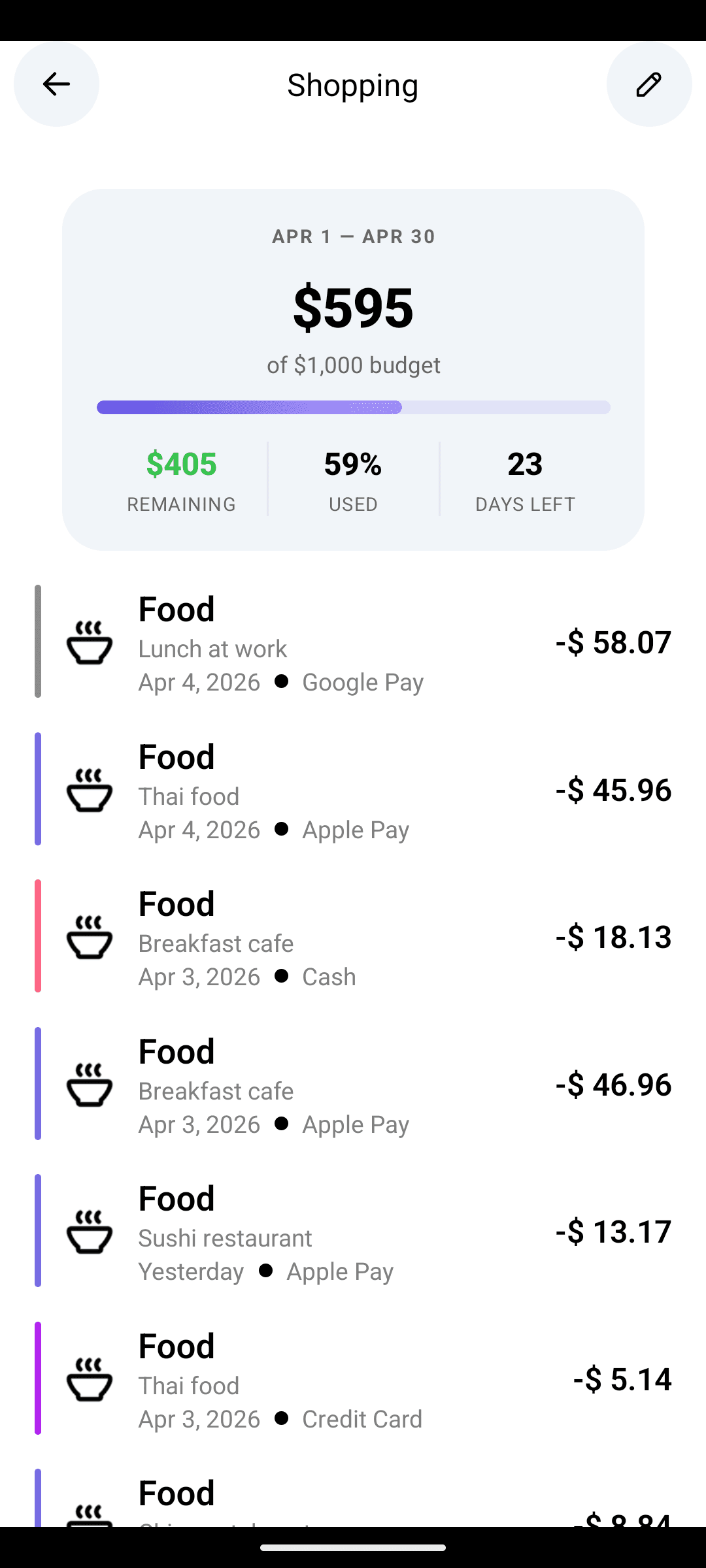
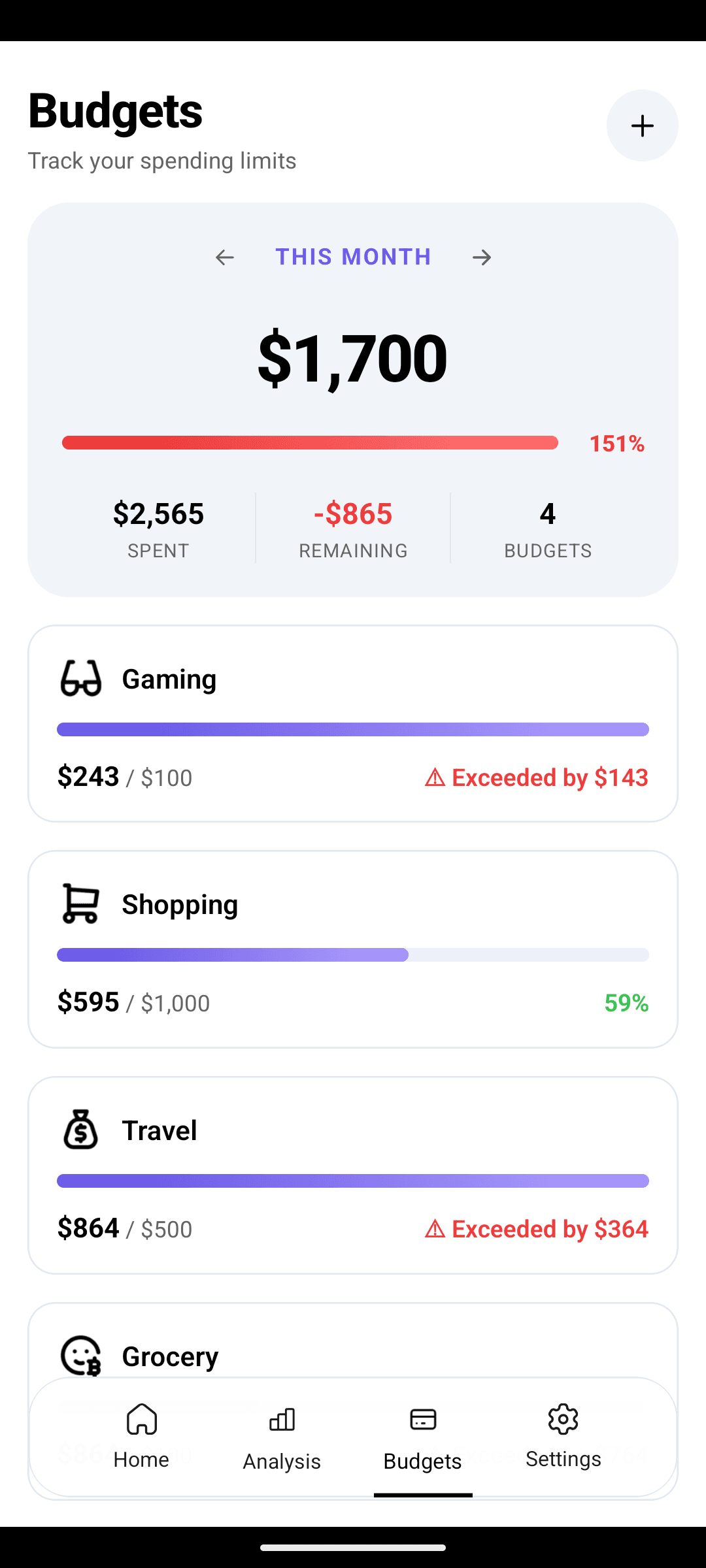
Use the real numbers you calculated as your per-category limits. CashFlow AI's smart budgets show you real-time progress bars, so you see when wants is about to cross 30% before it happens.
- 5
Automate the 20%
On payday, 20% gets moved to savings before you see it. Automate the transfer. If it doesn't hit your checking account, you can't spend it.
The "needs vs wants" test
This is where most people get tangled. A rule of thumb: if you had to pause a spend for 3 months and nothing important would break, it's a want.
Needs
- Rent or mortgage
- Utilities (electric, water, heat)
- Basic groceries (cook-at-home food)
- Transportation to work
- Health/auto/renters insurance
- Minimum debt payments
- Basic phone plan + internet
Wants
- Restaurant meals and delivery
- Streaming and subscriptions
- Gym, hobbies, entertainment
- Travel and vacations
- Upgrades (nicer car, bigger apartment)
- Gifts, tips, spontaneous shopping
- Premium phone/internet tiers
A few edge cases people get wrong:
- A car payment is a need; a luxury lease is a want. The basic cost of getting to work is essential. The premium above it isn't.
- Groceries are a need; specialty food delivery is a want. Cook-at-home ingredients count; meal kits and restaurant takeout don't.
- Basic internet is a need; premium streaming tiers aren't. You need internet to work. You don't need the 4K Ultra plan with six profiles.
The honest version of this test is uncomfortable. That's the point.
When the rule breaks — and what to do
"My rent alone is 45% of my income"
Common in high-cost metros. You have three options:
- Lower the rent (roommate, smaller place, move). Highest leverage; hardest in the short term.
- Raise the income (promotion, side income, switch jobs). Takes longer but resets the whole equation.
- Adjust the split temporarily — 60/25/15 while you work on #1 or #2. Just don't let "temporary" become "permanent."
Never cut savings below 10%. A lower savings rate is the thing that keeps people stuck.
"I have high-interest debt"
If you're carrying credit-card debt at 20%+ APR, flip the 20% bucket entirely toward debt payoff until it's gone. Every dollar paying down a 22% APR is mathematically the same as a 22% guaranteed return — a trade you'd take anywhere else. See how to get out of debt with an AI budget for the full playbook.
"I have irregular income"
The rule still works, but you apply it to your baseline, not your average. Figure out the low end of your typical monthly income, apply 50/30/20 to that, and route the rest (when it comes in) straight to savings. Full guide here.
"My savings rate is already 30%+"
Great problem to have. Use 50/20/30 (needs, wants, savings) and accelerate your timeline to financial independence. The rule is a minimum, not a cap.
Common mistakes
Budgeting with gross income
You don't actually see gross income. Taxes and benefits come out before the money lands. Using gross numbers inflates every bucket and causes a shortfall that looks like bad discipline but is just bad math. Always use net.
Forgetting about irregular expenses
The 50/30/20 rule is monthly. But car insurance is every 6 months, property tax is once a year, and holiday spending spikes in December. If you don't plan for these, they blow up the monthly split.
The fix: sinking funds. Divide each irregular expense by 12 and stash that amount monthly. It comes out of needs (for car registration) or wants (for Christmas) — but it gets saved, so it doesn't crash the budget when it hits.
Treating 20% as the ceiling
If you can afford to save more, save more. The rule gives you permission to stop worrying once you're at 20% — but most personal finance outcomes are set by how much you save above 20%, not at it.
How to track it without burning out
You don't need a spreadsheet. You need one quick habit and one tool:
- Log every spend, same day. Takes 5 seconds per entry with CashFlow AI's natural-language input.
- Check the split once a week. Friday morning is the sweet spot — late enough to see the week clearly, early enough to adjust the weekend.
- Review once a month. The 1st or the 15th. Adjust category budgets, note what's drifting, decide one thing to change next month.
That's it. Five minutes a day, two minutes a week, fifteen minutes a month.
Stop guessing whether your budget is working. Start seeing it.
See your needs/wants/savings split update in real time. Free on Android.The one-sentence version
Take-home × 0.5 for needs, × 0.3 for wants, × 0.2 for savings — and automate the savings first so you can't skip it.
If you remember nothing else from this guide, remember that sentence.
FAQ
See the FAQ block above.
Download CashFlow AI free on Android. For the monthly AI brief that auto-tags every transaction into your 50/30/20 split, see Pro.
Related:
FAQ
Is the 50/30/20 rule based on gross or net income?+
Net income — the money that actually lands in your bank account after taxes, healthcare premiums, and retirement contributions come out. Budgeting with gross income inflates every category and sets you up for monthly shortfalls.
What counts as a 'need' vs a 'want'?+
Needs are the things that would cause real damage if they stopped: rent, utilities, groceries (not restaurants), transport to work, insurance, minimum debt payments. Wants are every other discretionary choice — even the ones that feel essential, like streaming, dining out, or nicer gym memberships. The test: could you pause it for 3 months without breaking something important?
What if my 'needs' are already more than 50%?+
Common in high-cost cities. Don't force the rule — use it as a target. If needs are at 65%, the realistic split might be 65/20/15 until you can lower housing or raise income. Keep savings at 15% minimum; cutting it below that defeats the rule's purpose.