Personal finance sounds complicated because the industry makes it sound complicated. In reality, the fundamentals fit on a single page. If you can get six things right — tracking, budgeting, an emergency fund, debt, credit, and basic investing — you've covered 95% of what matters for your financial life.
This guide walks through each one in the order you should actually tackle it. No jargon, no products you need to buy, no sales pitches for specific funds. Just the moves that actually work.
What you'll walk away with
- Track every expense for 30 days before you try to change anything.
- Build a $1,000 starter cushion before anything else.
- Pay off high-interest debt (20%+ APR) before investing beyond employer-match.
- Automate savings on payday — don't leave it to end-of-month willpower.
- Start investing early, even a small amount. Time matters more than the amount.
- The habits are the point. The numbers take care of themselves.
The foundation: awareness before action
Before you open a budget app, cancel a subscription, or research investment accounts, do one thing: track every dollar you spend for 30 days.
This is the single step most personal finance advice skips. Every plan on the internet assumes you already know where your money goes. Almost nobody does, and the gap between "what I think I spend" and "what I actually spend" is usually 20–40%.
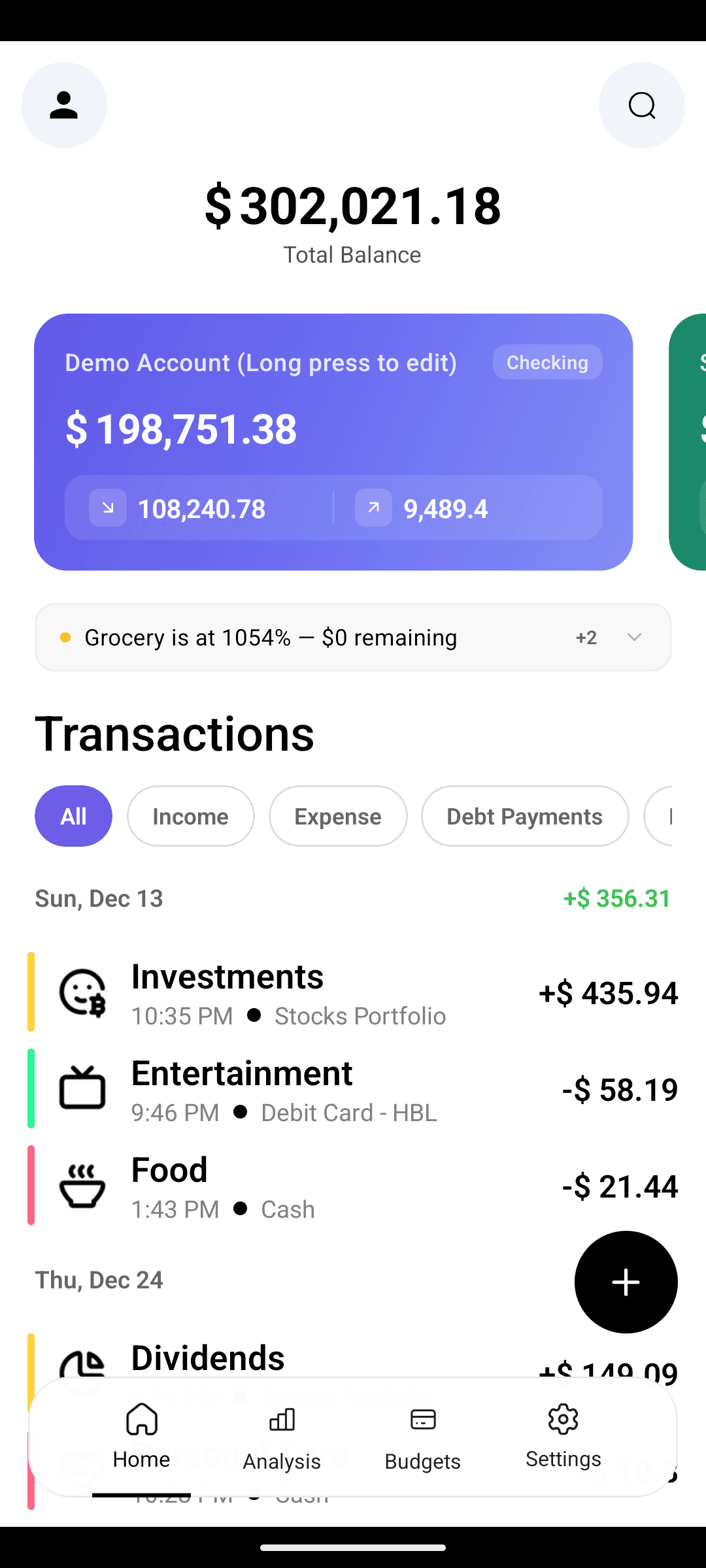
You can do this with CashFlow AI in about 5 seconds per expense — type "coffee 4" or "gas 45" and it gets logged, categorized, and counted automatically. See how expense tracking actually works for the full mechanics.
After 30 days, you'll have something most people never have: a real, unbiased picture of your spending. Only then does the rest of this guide become useful.
Step 1: build a budget that fits your life
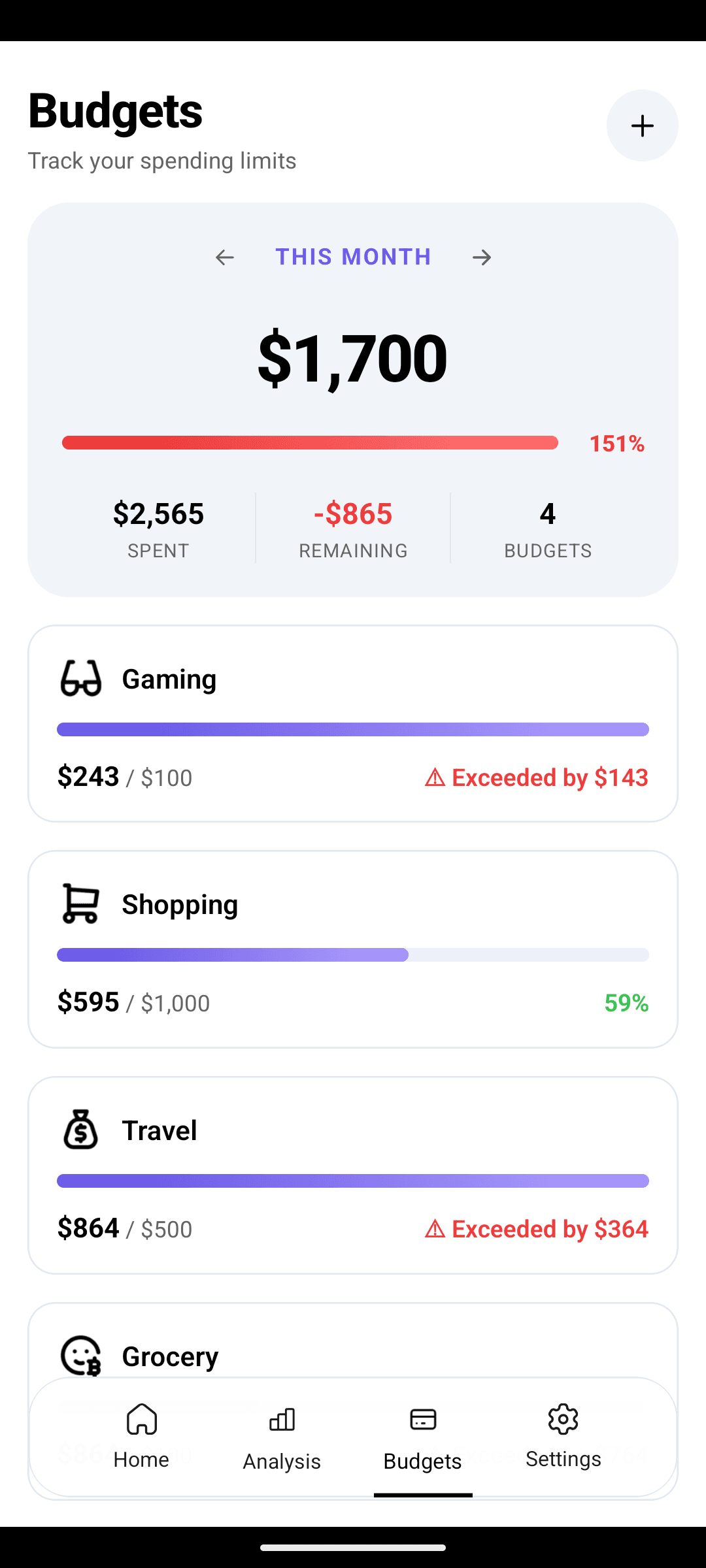
Budgets are unpopular because most budget advice asks you to track and decide on every individual purchase. That's exhausting, which is why most budgets last three weeks.
The two methods that actually work for beginners:
Option A: the 50/30/20 rule
- 50% of net income to needs (rent, utilities, groceries, transport, insurance, minimum debt)
- 30% to wants (dining, entertainment, hobbies, travel)
- 20% to savings and debt payoff above minimums
Simple, sustainable, gets most people 80% of the way. Full guide here.
Option B: zero-based budgeting
Every dollar gets assigned to a category before the month starts. Tighter control, better for specific goals. Full guide here.
If you're new to budgeting, start with 50/30/20. Graduate to zero-based if you need more precision or are paying off debt.
Step 2: the starter emergency fund ($1,000)
Before you invest a dollar, before you pay extra on low-interest debt, get $1,000 in a separate savings account.
Why $1,000? Because that's enough to absorb most small emergencies without needing a credit card. A tire, a copay, a minor car repair, one bad week at work. Below $1,000, every unexpected expense becomes a credit-card balance, which becomes interest, which becomes a reason the budget never works.
Most people can build this in 4–8 weeks by:
- Canceling 2–3 forgotten subscriptions ($20–$60/month recovered)
- Cutting delivery orders in half for a month ($100–$300 recovered)
- Redirecting any tax refund, bonus, or windfall
$1,000 is not the full emergency fund — that comes later. But it's the first step that stops the bleeding.
Step 3: handle high-interest debt
High-interest debt (credit cards, payday loans, store cards) is mathematically the highest-leverage problem in personal finance. A credit card at 22% APR means every $100 you don't pay off is costing you $22/year — guaranteed. There's no investment that reliably beats that.
Before investing beyond an employer 401(k) match, pay off anything over 10% APR.
Two payoff methods both work:
- Avalanche — highest APR first. Fastest mathematically. Best if motivated by math.
- Snowball — smallest balance first. Slower, but provides quick wins. Best if motivated by momentum.
Pick the one you'll actually finish. See how to get out of debt with an AI budget for the full strategy.
What counts as "high-interest"?
- Credit cards (typically 18–29%): always attack first
- Personal loans (8–15%): attack next
- Student loans (4–8%): pay minimums, invest in parallel
- Mortgages (3–7%): pay on schedule, don't accelerate at the expense of investing
Step 4: the full emergency fund
Once high-interest debt is gone, go back to the emergency fund and finish it.
The target: 3–6 months of essential monthly expenses, in a high-yield savings account (HYSA) at a bank different from your checking.
- 3 months if you have stable income, no dependents, and a strong professional network
- 6 months if you have dependents or single-income household
- 9–12 months if self-employed, in a volatile industry, or both
Full guide to calculating your target here.
An HYSA in 2026 pays 4–5% APY, which means the fund covers inflation while it sits. Don't invest this money — it needs to be there instantly when you need it.
Step 5: start investing (retirement first)
This is where the compounding magic begins. A dollar invested at 25 is worth roughly 10x at 65. A dollar invested at 45 is worth about 2.5x at 65. Time in the market matters more than timing the market.
The retirement priority order
1. Employer 401(k) match first. If your employer matches contributions, contribute at least enough to get the full match. This is free money — usually a 50–100% instant return. Skipping this is leaving thousands of dollars a year on the table.
2. Max out a Roth IRA (if eligible). $7,000/year contribution limit in 2026, $8,000 if 50+. Contributions are after-tax, but every dollar grows tax-free forever. For most people under ~$150K income, the Roth IRA is the single best retirement account available.
3. Max out the 401(k). Employee contribution limit in 2026 is $23,500 ($31,000 if 50+). Once you're funding match + Roth IRA, the 401(k) is the next stop.
4. Taxable brokerage. After tax-advantaged accounts are maxed, the rest goes here. Same math, just no tax benefit on contributions.
What to invest in
For 95% of people: low-cost, broad-market index funds. Not individual stocks, not crypto, not whatever's trending this quarter.
Two-fund portfolios that work:
- 80% total US stock market (e.g., VTI, FXAIX, SWTSX) + 20% international (VXUS, IXUS)
- 70% US stock market + 20% international + 10% bonds (BND, AGG)
The difference between these portfolios over 30 years is small. The difference between investing at all and not investing is enormous.
Step 6: build your credit
Credit score (FICO or VantageScore) determines what interest rates you'll be offered on mortgages, car loans, and credit cards. A 100-point difference in credit score can be a difference of hundreds of thousands of dollars over the life of a mortgage.
The five factors
| Factor | Weight | What to do | |---|---|---| | Payment history | 35% | Pay every bill on time. Autopay the minimum at least. | | Credit utilization | 30% | Keep balances under 30% of limits. Under 10% is better. | | Credit age | 15% | Don't close old credit cards. Age is on your side. | | Credit mix | 10% | A mix of cards and loans helps. Don't optimize for it. | | New credit | 10% | Avoid opening 3+ new accounts in a short window. |
The five moves that cover 90%
- Autopay every bill. One missed payment can drop your score 50–100 points.
- Keep balances low. Carry-over balances on credit cards hurt credit utilization — even if you pay in full by the due date, the reported balance is what the bureau sees.
- Don't close old cards. Even if you don't use one, the age and available credit help.
- Check your credit report annually. AnnualCreditReport.com — free, official. Dispute any errors.
- Use 1–2 credit cards actively. More than that adds complexity without benefit for most people.
Step 7: the big goals (house, family, retirement)
With steps 1–6 in place, you can think about larger goals:
- House down payment — 10–20% of purchase price, saved in a HYSA over 2–7 years. Don't invest this in stocks; the timeline is too short for market volatility.
- Kids — roughly $250K–$300K per child through age 18 in the US (adjusted for 2026 inflation). Start a 529 plan early if you plan to fund college.
- Financial independence — roughly 25x annual expenses in investments, sometimes called "FIRE." A $50K/year lifestyle needs about $1.25M invested to sustain indefinitely (the "4% rule").
None of these require exotic strategies. They all boil down to consistent saving and low-cost index investing over long periods.
The habits that actually produce outcomes
If you zoom out from every strategy in this guide, five habits do 80% of the work:
- 1
Log every expense daily
5 seconds per transaction with CashFlow AI. Never batch more than a day. The awareness alone cuts 10–15% of spending.
- 2
Automate everything that can be automated
Savings transfers, bill payments, retirement contributions, investment purchases. Remove willpower from the loop.
- 3
Review weekly (2 minutes), monthly (15 minutes)
Friday: scan category bars, adjust the weekend. First of the month: review what worked, decide one thing to change. Anything more elaborate and you'll stop doing it.
- 4
Raise income over time
There's a floor on how low expenses go; there's no ceiling on income. Negotiate raises, develop skills, switch jobs when appropriate. A 20% income increase with stable expenses destroys a 20% expense cut — every year.
- 5
Match lifestyle to income, not expectations
Lifestyle inflation is the biggest killer of long-term wealth. A raise should go 50% to savings/investing, 50% to lifestyle. That's how you get ahead instead of running in place.
What you don't need (yet)
The internet will try to sell you:
- Complicated investment strategies — you don't need them. Index funds beat 90% of professionals over 20-year windows.
- Expensive courses — this guide is sufficient starting material, and your bank's website has the rest.
- Crypto / NFTs / speculative bets — these are not personal finance. They're gambling. Gamble only with money you'd be fine losing entirely.
- Whole life insurance — term insurance is cheaper and usually sufficient. Whole life is sold, not bought.
- Rental property — real estate is a second job, not a side hustle. Build index fund wealth first.
Come back to the advanced topics after the basics are working.
Get a real picture of your money in 30 days.
Start with tracking — the foundation of every other step. Free on Android.The order matters
One last reminder: the steps in this guide are sequenced intentionally.
- Track → 2. Budget → 3. $1,000 cushion → 4. High-interest debt → 5. Full emergency fund → 6. Retirement investing → 7. Big goals
Don't skip steps. Don't invest while carrying 22% APR credit-card debt (that's a guaranteed loss). Don't worry about a 529 plan while you have no emergency fund. Don't chase a 7% investment when you have an 8% student loan.
The order is the plan. Follow the order and the compounding does the work.
FAQ
See the FAQ block above.
Download CashFlow AI free on Android. For the monthly AI brief that automates steps 1 and 2 of this guide, see Pro.
Related:
FAQ
Where should I start if I have zero savings and some debt?+
Start with tracking — log every expense for 30 days before changing anything. You can't fix what you can't see. From there: build a $1,000 starter cushion, then pay minimums on all debts while attacking the highest-interest one. Investing can wait until the cushion is in place and high-interest debt is handled.
How much should I save each month?+
Aim for 20% of net income as a long-term target, split across an emergency fund, retirement, and other goals. If you're starting from zero, even 5% is meaningful — the habit matters more than the percentage early on. Automate whatever amount you pick; what you see, you spend.
Do I need a financial advisor?+
Not for most people at the beginning. The fundamentals — track spending, build an emergency fund, pay off high-interest debt, contribute to retirement — don't require paid advice. Consider a fee-only fiduciary advisor once your situation gets complicated (six-figure investments, business ownership, inheritance, major life events).