You set a budget. You downloaded the app. You logged expenses for two weeks. And then, quietly, you stopped checking. Three weeks later, you're back to the old patterns and wondering if you just aren't disciplined enough.
You are disciplined enough. You're missing a different habit — and it's not the one you think.
The short version
- Setting a budget is 10% of the work. Reviewing the data is the other 90%.
- Data visibility interrupts emotional spending — willpower never had to.
- Three review cadences: daily glance, weekly scan, monthly brief.
- Once reviewing becomes automatic (~90 days), budgeting stops feeling like work.
The real reason budgets fail
Every article you've read frames budget failure as a discipline problem. "Try harder. Be more mindful. Resist the coffee."
That framing is wrong, and it's why nothing sticks. The real problem is simpler: at the moment you're making a spending decision, you don't have the data to make it well.
Standing in the grocery aisle on a Wednesday, you genuinely don't know whether you've spent $280 or $480 this month on food. So you grab the second bottle of wine. That's not a willpower failure — it's an information failure.
People who stick to budgets aren't more disciplined. They've built a habit the rest of us haven't: they review the numbers, regularly, before they decide.
Data as an interrupt pattern
Here's what happens when you check your category balance before a non-essential purchase:
- You're about to spend $60 on takeout.
- You open the app. Dining Out is at 82% with 11 days left in the month.
- The decision changes. You cook.
That two-second data check interrupts the emotional loop. There's no discipline involved. You didn't "resist." You just saw a number that made the choice obvious.
This is the entire mechanism. Not willpower — interruption. And the only way to get the interrupt to fire is to have the data in front of you, already loaded by the habit of checking.
The three review cadences
The review habit isn't one thing. It's three, layered.
The daily glance (15 seconds)
Open the app once a day. Usually after the first spend — breakfast, the morning coffee, the first transaction. You're not analyzing anything. You're just looking at the progress bars.
15 seconds. You see green, yellow, or red across your categories, and you close the app. If Dining Out is suddenly orange, that's tonight's data point.
The daily glance isn't about catching problems. It's about keeping your spending map loaded in your head so that when a decision pops up six hours later, the data is already there.
The weekly scan (2 minutes)
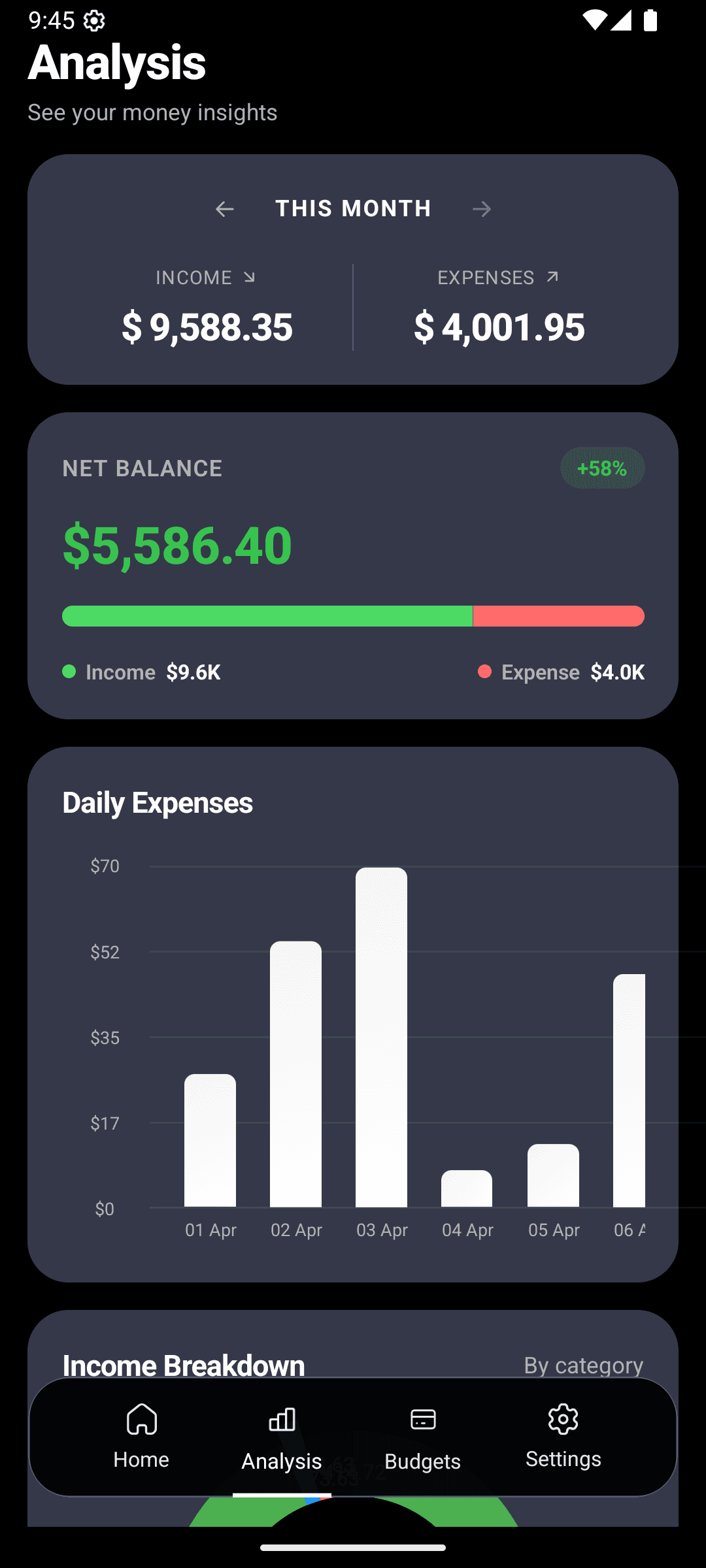
Friday morning, or Sunday evening — whichever fits your rhythm. You open the analytics view.
You're looking for three things:
- Which categories are trending over their weekly pace?
- Is there any expense you don't recognize?
- What does the weekend need to look like?
That's it. Two minutes. Not an audit — a scan. You make one decision: how the next seven days should go.
The monthly brief (15 minutes)
First of the month. Coffee. Open the full analytics view. Compare to last month.
- What drifted higher?
- What categories stayed flat — which is sometimes a win, sometimes drift?
- Is there a subscription to cancel?
- Is there a budget to raise or cut?
Make one change for the coming month. Just one. Stacking five changes is how people abandon the habit.
The identity shift
Something interesting happens around day 60 of consistent reviewing: the framing of why you're doing this changes.
Month one, the story you tell yourself is: "I'm trying to stick to a budget." It sounds like struggle.
Month two, it becomes: "I'm the type of person who knows where their money goes." It sounds like identity.
Tracking without reviewing
- Expenses land in the app; nobody looks
- Month-end reveals an ugly number — too late
- "I need more willpower"
- Budget survives 3 weeks, abandoned by week 4
- Frames money as a problem
Reviewing as ritual
- 2-minute Friday scan + 15-min monthly brief
- Drift caught within days, course-corrected
- "I know my spending pattern"
- Budget becomes boring — which means it's working
- Frames money as data you're fluent in
This shift matters because identity-based habits outlast motivation-based ones. The research is unambiguous: people who see themselves as "a runner" show up in ways people who are "trying to run more" don't. Same for money.
Pattern recognition compounds
In month one of reviewing, you see last week. That's useful.
In month three, you start recognizing your own rhythms:
- Spending spikes on Fridays and the Sunday after payday
- Dining out creeps up when work is stressful
- Grocery trips on an empty stomach cost 30% more than planned
- December is expensive in ways January never accounts for
In month six, you predict next Tuesday. You know that if Monday was rough, Tuesday's dining budget is at risk. You plan accordingly, not because you're "being careful" — because the pattern is obvious to you now.
This is self-knowledge, and it's one of the genuinely life-changing things the review habit produces. You stop being surprised by your own behavior. That's a kind of quiet confidence that doesn't come from any single budget spreadsheet.
The 30/60/90-day arc
What reviewing feels like across the first three months:
Days 1–30: awkward
Opening the app feels like homework. The data is incomplete. Some categories look wildly off because you missed logs, or because one weird month is distorting the picture. You'll want to quit on day 18.
Don't. This is the price of admission.
Days 30–60: clarifying
The data starts telling a real story. You have a month of history to compare against. The weekly scan gets easier — you know what "normal" looks like, so deviations stand out.
You start to notice spending before it becomes a problem. That's the first win.
Days 60–90: automatic
The daily glance becomes a reflex. The weekly scan slots into your routine — same time, same day, minimal thought. The monthly brief actually becomes interesting because you have enough data to see real patterns.
You stop thinking of yourself as "working on my budget." You're just — reviewing. The way some people just — exercise.
When reviewing stops feeling like work
There's a specific moment, usually between day 75 and day 100, when the habit crosses over.
Before: opening the app feels like effort, even if it's only 2 minutes. After: you notice a couple of days without checking and feel slightly uneasy. The data is your feedback loop, and you miss it when it's gone.
That's the tipping point. Past it, sticking to the budget isn't an act of discipline — it's a byproduct of a habit you'd be uncomfortable breaking.
Most people never reach this point because they treat tracking and reviewing as the same thing. They're not. Tracking is logging expenses; reviewing is looking at the aggregate. Log without reviewing and you're producing data nobody reads. Review without logging and there's nothing to read. You need both. But the review is the part that changes behavior.
How to build the review habit in a week
- 1
Anchor the daily glance to an existing behavior
Pair it with something you already do: after morning coffee, after logging the first spend, before bed. The anchor matters more than the time of day. "After I lock my front door at night, I open the app for 15 seconds" works better than "review daily."
- 2
Schedule the Friday 2-minute scan
Literally put it on your calendar. 9:00 AM Friday. 2 minutes. Make it as boring and recurring as a meeting. After 3 weeks you won't need the calendar invite — but don't skip the scaffolding before the habit is solid.
- 3
Pair the monthly brief with something enjoyable
First Sunday of the month. Coffee, favorite chair, 15 minutes in the analytics view. Pair the review with a small reward so your brain files it in the "good time" bucket, not the "chore" bucket.
That's the whole system. Three cadences, three anchors, and 90 days of showing up.
The data-first mindset
If this guide leaves you with one idea, make it this: the budget doesn't keep you on track. The review does.
Setting a budget is a one-time decision. Reviewing is the thousand tiny course corrections that happen when you actually see the numbers. Without the review, the budget is just a wish. With the review, it's a feedback loop — and feedback loops are the only things in behavior science that reliably change what humans do.
If you've tried to budget before and it didn't stick, the thing that was missing wasn't willpower. It was the 2-minute Friday scan nobody told you about.
Start the review habit that makes budgeting stick.
A 15-second glance and a 2-minute weekly scan. That's the whole habit. Free on Android.Related reading
- Where does my money go? Reading your spending in 60 seconds — the mechanics of reading the analytics view
- How to actually stick with expense tracking — the notification layer that cues the review habit
- How to stop overspending — the real-time budget alerts that fire between your review sessions
- The CashFlow AI method — capture, categorize, course-correct